Category: attractor
-
Rössler.Attractor
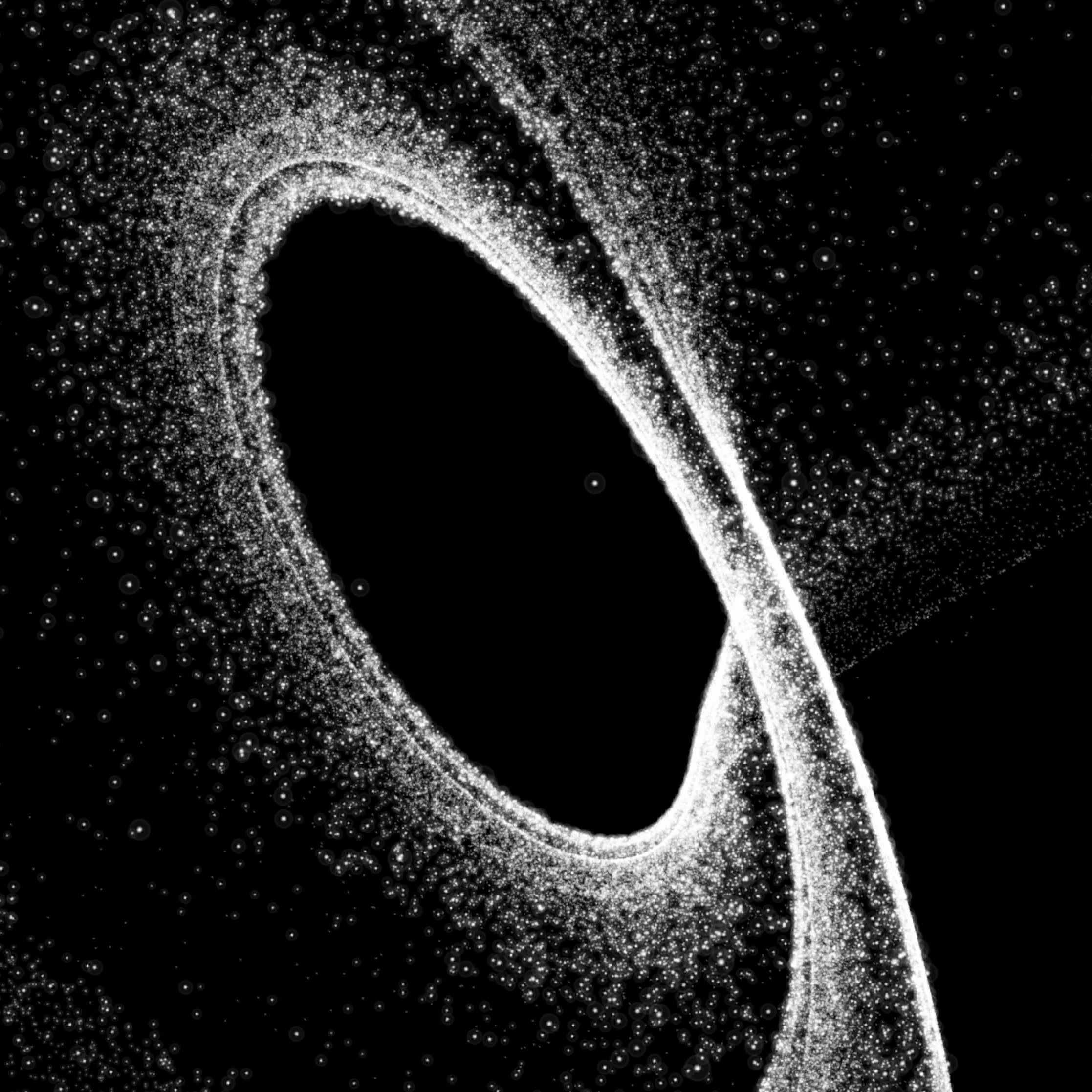
A chaotic trajectory in three dimensional space.
-
SAND.TRAVELER
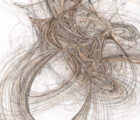
The Sand Traveler is a rendering of 1,000 traveling particles, each in pursuit of another. Over time, patterns of travel are exposed as sweeping paths of color. The Sand Traveler uses a pursuit algorithm similar to the City Traveler. The significant difference is the way that pixels are laid down between the travelers. Three variations…
-
HENON.PHASE.DEEP
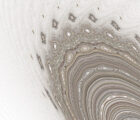
a Henon Phase expansionbased on code by Paul Bourke In hopes and fears of something unknown, we travel deep into the Henon strange attractor (see Henon Phase). All of the images on this page were created by exposing the traveling patterns of particles over long periods of time. The particles are trapped in the simple,…
-
HENON.PHASE
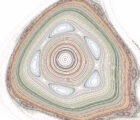
In computing time scales, the Henon Phase is an ancient strange attractor. A point is moved through two dimensional space based on the following transformational equations: xn+1 = xn cos(a) – (yn – xn2) sin(a)yn+1 = xn sin(a) + (yn – xn2) cos(a) These images plot the phase space of the Henon system at arbitrary…
-
BIT.10001
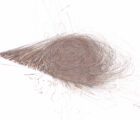
Exposing the paths of particles as they accelerate around an infinite numerical attractor, we see a process of flow ranging from gentle to chaotic. It is an amazing thing to render 10,001 particles, in three dimensions, in real time. This system gives us the luxury of doing just that while simultaneously recording the results over…
-
CUBIC.ATTRACTOR
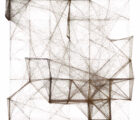
A minimalist modification of the City Traveler system. Cities are initiated in grid locations. Each chooses another grid location at random and moves to it. 0000 0001 0002 0003 0004 0005 0006 0007 Note how some cities move beyond the extent of the original instantiation. This is a result of cities holding inertia as they travel towards…
-
BUDDHA.BROT
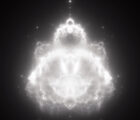
The Buddhabrot Set is a re-visualization of the familiar Mandelbrot Set using a technique invented by Melinda Green. Instead of selecting points on the real-complex plane, initial points are selected at random from the image region. The point is iterated through the function, z = zˆ2 + c, where z has components in both the…