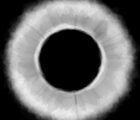
Medium: Processing
-
FAR.AWAY.PIXEL.GALAXY

Somewhere in a pixel galaxy, far far away… Programmed in Processing By Jared S Tarbell In Albuquerque, New Mexico Date unknown
-
NOISE.FIELD
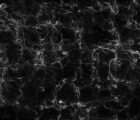
Particles follow paths derived from a two dimensional Perlin noise function. Paths are rendered with translucent pixels, making common areas bright. Where are you in this picture? The evolution of this algorithm, presented in reverse order. Programmed in Processing By Jared S Tarbell In Albuquerque, New Mexico, USA Around 1:10pm February 2, 2015
-
INVADER.SUPER.RING
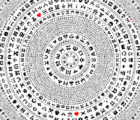
The Invader is a special grid construction of black and white squares. I have generated millions of them. They are familiar friends. Previously arranged in order or in a fractal, here they are arranged in concentric rings. Rings vary in width. Invader scale and distribution is set to fit accordingly. One variation identifies and highlights heart shaped Invaders in…
-
CIRCLES.INSIDE.CIRCLES
Packing circles into a finite space is fun. Especially when you use lazy algorithms that place and test, rather than do any hard math. One such classic algorithm is this, place a very small circle into a field and grow that circle until it hits another circle or the edge. Repeat until no room is left for…
-
YARN.STRETCHER
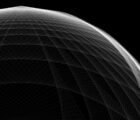
Exploration of a childhood craft stretching yarn between two adjacent lines of pins, many many many times. I often use red in debugging situations. Red helps isolate changes to the algorithm. Programmed in Processing By Jared S Tarbell In Albuquerque, New Mexico, USA Around 9:54pm May 1, 2015
-
BINARY.AGES
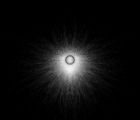
A system of path tracing particles evolves continually from an initial creation event. Ages of darkness play arbitrarily with ages of light. This is an adaptation of Binary.Ring (2003). In Binary.Ages II, many creation events instantiate across the field, each ring of light birthing its own age as the others fade. Here a single origin persists, its…
-
ORBIT.CLOCK
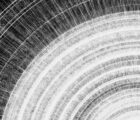
Nodes orbit a central location in groups of variable intervals. Lines connect nearby nodes. Syncopated cycles move groups of nodes around a central location. The elements of the clock construction are exposed over time. Movement reveals a tapestry of relationships. Download Source Code Programmed in Processing By Jared S Tarbell In Albuquerque, New Mexico Around…
-
NOISE.CIRCLE
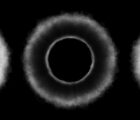
A rotating line of white noise reveals something looking back at me. In this post, the images show my development process. It begins with a rough sketch of a line drawing process and advances towards the final result, seen at the bottom of this page. I often begin sketches without a goal in mind. I…
-
METATRON’S.CUBE
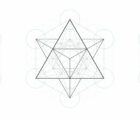
During times of creative drought, I sometimes turn to classic geometric forms. Today I recreated well known constructions from the Metatron Cube. I was surprised to find the dodecahedron in there. Illustrated in CorelDRAW and Processing By Jared S Tarbell In Albuquerque, New Mexico, USA Around 5:15pm August 1, 2015
-
Spiritual.Ring